
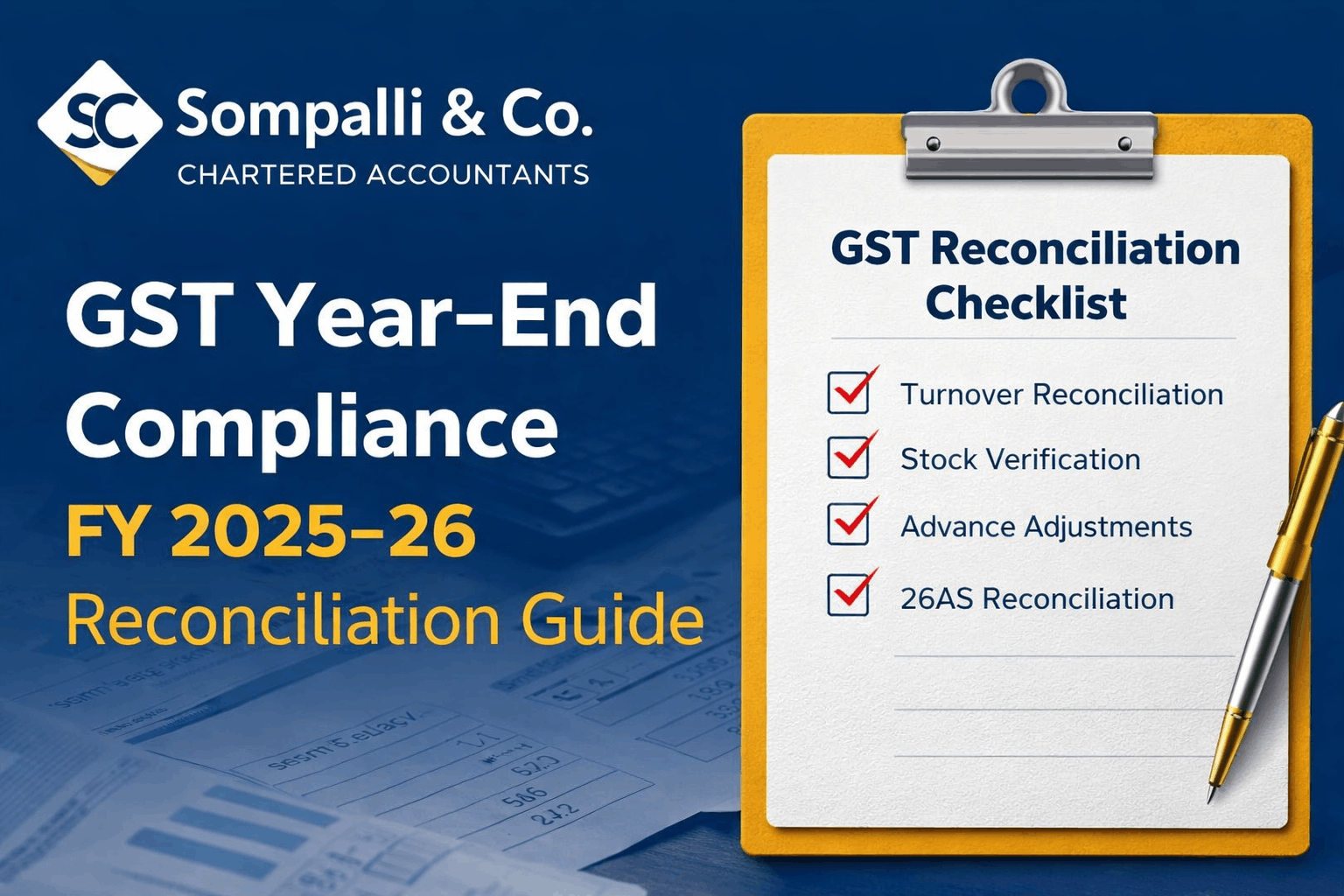
As FY 2025–26 draws to a close, businesses must ensure that their GST
returns accurately reflect their books of accounts. Discrepancies left
unaddressed become the basis for scrutiny notices, demand orders, and
penalties — often discovered only after the filing window has closed.
The reconciliations below are the ones that matter most. Each targets a
specific point of mismatch that commonly arises between books, GSTR-1,
and GSTR-3B.
📊 1. Turnover Reconciliation
Reconcile your turnover as per books of accounts with outward supplies
reported across all monthly GSTR-1 and GSTR-3B filings for FY 2025–26.
What to match:
- Gross turnover per P&L / trial balance
- Table-wise outward supply totals from GSTR-1 (Tables 4, 5, 6, 9, 10, 11)
- Taxable value and tax declared in GSTR-3B Table 3.1
Common reasons for variance:
- Supplies reported in the wrong tax period
- Advances received but not reflected in GSTR-1 (via Receipt Voucher)
- Rounding differences across CGST, SGST, and IGST heads
- Exempt or nil-rated supplies omitted from GSTR-1
Why it matters: GSTR-9 Table 5 requires you to declare turnover
reconciled across all returns. Any unexplained difference here is the
first thing an audit officer examines.
🔁 2. Credit Note and Debit Note Reconciliation
Credit notes and debit notes issued during the year must be accurately
reflected in GSTR-1 (Table 9B) and accounted for in GSTR-3B. A mismatch
here reduces or inflates your net taxable turnover incorrectly.
What to verify:
- All credit notes issued (for returns, rate differences, cancellations)
are reported in GSTR-1 in the correct period — not later than the
earlier of:
- 30th November following the end of the financial year, or
- Date of filing the Annual Return
- Debit notes issued are mapped to the correct original invoice
- Net impact on taxable value and ITC of the recipient is consistent
with what is reported
Key check: Cross-verify credit notes appearing in your GSTR-1 against
ITC reversed in your recipients' GSTR-3B (visible via GSTR-2B). A credit
note issued by you should result in an ITC reversal for your customer —
if that is not reflecting, follow up before the year closes.
Common error: Credit notes issued in March 2026 for FY 2025–26
transactions that have not been uploaded to GSTR-1 by the due date —
these cannot be claimed after the Annual Return is filed.
✏️ 3. GSTR-1 Amendments
Any invoice or credit/debit note that was reported incorrectly in a
previous month's GSTR-1 can be amended in a subsequent return using
Table 9A (amended invoices) and Table 9B (amended credit/debit notes).
What to reconcile:
- List all amendments made during FY 2025–26 (Table 9A / 9B entries)
- Verify that the amended values flow correctly into GSTR-3B for the
period in which the amendment was made
- Confirm that corresponding ITC adjustments have been made in the
recipient's books where applicable
Critical deadline: Amendments to GSTR-1 for FY 2025–26 can only be
made up to the due date of the September 2026 GSTR-1 or the filing of
GSTR-9, whichever is earlier. Beyond this, corrections are not possible
— any omission becomes a permanent discrepancy.
Practical tip: Run a comparison of original vs amended invoice
values across all months. Where the net difference is significant,
ensure the differential tax has been paid via GSTR-3B DRC-03 if
applicable.
🧮 4. ITC Reconciliation — GSTR-2B vs Books
Input Tax Credit availed in GSTR-3B must be reconciled against GSTR-2B
(auto-generated ITC statement based on supplier filings) and the purchase
register in your books.
Three-way reconciliation:
| Source | What it shows |
|---|---|
| Books of accounts | ITC recorded basis invoices received |
| GSTR-2B | ITC eligible as per supplier's GSTR-1 filings |
| GSTR-3B Table 4 | ITC actually claimed |
What to check:
- ITC in books but not in GSTR-2B → supplier has not filed or has
filed incorrectly — follow up with vendor
- ITC in GSTR-2B but not claimed in GSTR-3B → eligible ITC left on
the table — claim before the deadline
- ITC claimed in GSTR-3B but not in GSTR-2B → risk of reversal
with interest during audit — verify and reverse if ineligible
Deadline for claiming ITC: ITC pertaining to FY 2025–26 invoices
must be claimed no later than the earlier of:
- 30th November 2026, or
- Date of filing GSTR-9 for FY 2025–26
🔄 5. Output Tax vs ITC Utilisation Reconciliation
Verify that the sequence of ITC utilisation as per your GSTR-3B filings
complies with the order of set-off prescribed under Section 49 and
Rule 88A of the CGST Rules.
Correct order of ITC set-off:
- IGST ITC → first against IGST liability
- IGST ITC → then against CGST liability
- IGST ITC → then against SGST liability
- CGST ITC → only against CGST liability
- SGST ITC → only against SGST liability
What to check:
- CGST ITC has not been used to offset SGST liability (or vice versa)
- Excess IGST ITC has been optimally utilised before using
CGST/SGST ITC
- Cash ledger payments are only for the remaining balance after ITC
set-off
Incorrect utilisation order does not change the final tax paid, but
it can result in excess cash outflow and suboptimal working capital
utilisation across the year.
🧾 6. Reverse Charge Mechanism (RCM) Reconciliation
Identify all inward supplies attracting Reverse Charge Mechanism (RCM)
during FY 2025–26 and confirm that:
- RCM liability has been declared and paid in GSTR-3B (Table 3.1(d))
- ITC of RCM paid has been availed in the same or subsequent return
(Table 4A(3)) — subject to eligibility - RCM payments are supported by proper Payment Vouchers in books
Common RCM categories to verify:
| Service | RCM Applicable? |
|---|---|
| Legal services from advocate | Yes |
| Goods Transport Agency (GTA) | Yes (if GTA opts for 5% rate) |
| Import of services | Yes |
| Security services | Yes |
| Renting of motor vehicles | Yes (specific cases) |
| Sponsorship services | Yes |
Note: RCM ITC can only be availed after the corresponding RCM
tax is paid in cash. Availing ITC before payment is a common error
flagged during audits.
🏦 7. E-Commerce and TCS Reconciliation
If your business receives payments through e-commerce operators
(Amazon, Flipkart, Swiggy, Zomato, etc.), the operator deducts
Tax Collected at Source (TCS) at 0.5% (CGST + SGST) on the net
taxable supply.
What to reconcile:
- TCS reflected in your Electronic Cash Ledger (GSTR-2B / GSTR-8
filed by operator)
- TCS credit against sales turnover declared in GSTR-1
- Settlement statements from the operator vs income in books
Common issue: Operators sometimes reflect sales in a different
period than when you book the income — ensure month-wise mapping
before filing GSTR-9.
✅ Year-End GST Reconciliation Checklist
| # | Item | Status |
|---|---|---|
| 1 | Turnover — Books vs GSTR-1 vs GSTR-3B | ☐ |
| 2 | Credit notes — all uploaded to GSTR-1 before deadline | ☐ |
| 3 | Debit notes — matched to original invoices | ☐ |
| 4 | GSTR-1 amendments — net tax impact verified | ☐ |
| 5 | GSTR-2B vs books vs GSTR-3B ITC — three-way reconciled | ☐ |
| 6 | Ineligible ITC reversed (Section 17(5), Rule 42/43) | ☐ |
| 7 | ITC utilisation order verified (Rule 88A) | ☐ |
| 8 | RCM liability paid and ITC availed correctly | ☐ |
| 9 | E-commerce TCS credits matched | ☐ |
| 10 | GSTR-9 / GSTR-9C data verified against all of the above | ☐ |
📅 Key Deadlines — FY 2025–26
| Filing | Due Date |
|---|---|
| GSTR-1 — March 2026 | 11th April 2026 |
| GSTR-3B — March 2026 | 20th April 2026 |
| Last date to claim ITC for FY 2025–26 | 30th November 2026 |
| Last date to amend GSTR-1 for FY 2025–26 | 30th November 2026 |
| GSTR-9 / GSTR-9C — FY 2025–26 | 31st December 2026 |
Final Note
The best time to address reconciliation gaps is before you file — not
after a notice arrives. Voluntary correction of mismatches carries far
lower consequences than discrepancies uncovered during departmental scrutiny.
At Sompalli & Co., we assist businesses with structured GST year-end
reconciliation reviews — identifying mismatches, quantifying exposures, and
preparing documentation before the Annual Return filing season.
Reach out to us for a reconciliation review tailored to your business for
FY 2025–26.
Disclaimer: This article is for general informational purposes only and
does not constitute professional tax or legal advice. GST provisions are
subject to change — please consult a qualified Chartered Accountant for
advice specific to your business.
 Urukundu